
Introduction
The Compressibility calculator determines the compressibility factor (Z), supercompressibility factor, and gas density at both base and operating conditions for a given gas composition, pressure, and temperature. Ten industry-standard calculation methods are supported, ranging from simple specific-gravity-based correlations to full compositional equations of state. These results are used throughout all calculations to convert between ideal and real gas volumes in pipe flow, measurement, and other hydraulic calculations.
Important: All calculation methods require a gas properties file (.prp) to be assigned via the Base Conditions screen. Each method was developed for methane-heavy natural gas mixtures and has its own applicable pressure, temperature, and composition range. Selecting an appropriate method based on gas composition is the user’s responsibility.
For pipe flow design calculations, ignoring the compressibility factor (Z = 1.0) is generally acceptable at pressures up to 100 psig and may yield acceptable results up to 400 psig; for measurement calculations, use of an appropriate compressibility constant is nearly always recommended regardless of operating pressure.
Background
Many pressure–volume–temperature (PVT) relationships used in gas system calculations are based in the behaviour of an ideal gas. The Ideal Gas Law – PV = nRT – can be expressed as the Combined Gas Law below, assuming the moles of gas contained in V are held constant:
\frac{P_1 V_1}{T_1} = \frac{P_2 V_2}{T_2}In practice, no perfect gas exists. Real gases — including natural gas mixtures — deviate from ideal behaviour, particularly at high pressures and low temperatures. A compressibility factor (Z) quantifies this deviation. By inserting Z into the gas law, we obtain the Real Gas Law:
\frac{P_1 V_1}{T_1 Z_1} = \frac{P_2 V_2}{T_2 Z_2}Where:
P1, P2 − Absolute pressures at conditions 1 and 2 (psia)
V1, V2 − Volumes at conditions 1 and 2 (ft3)
T1, T2 − Temperatures at conditions 1 and 2 (°R)
Z1, Z2 − Compressibility factors at conditions 1 and 2
For an ideal gas, Z = 1.0 exactly. For real natural gas at pipeline operating pressures, Z typically ranges from about 0.85 to 0.999 depending on pressure, temperature, and composition.
Ignoring the compressibility factor in pipe flow design calculations produces conservative results — slightly oversized pipes, slightly underestimated flow rates, and slightly overestimated pressure drops — which is generally acceptable for design work. For measurement and custody transfer calculations, the compressibility factor correction is nearly always applied to ensure accurate volume accounting.
Equations
Compressibility Factor
The calculator supports ten seperate compressibility factor calculation methods. The methods span a range of required input data, accuracy, and applicable operating ranges. Only the GPSA method uses a closed-form equation; all other methods implement multi-parameter iterative procedures whose full details are contained in their respective reference documents.
| Method | Required Inputs | Applicable Range / Notes |
|---|---|---|
| AGA-NX19-Analysis | Full mole fractions | Legacy; pipeline and measurement use |
| AGA-NX19-Heating Value | Heating value, CO₂ & N₂ fractions | Legacy; reduced composition data |
| AGA-NX19-Methane/Gravity | SG, CH₄, CO₂ & N₂ fractions | Legacy; minimal composition data |
| AGA-NX19-Standard | SG, CO₂ & N₂ fractions | Legacy; minimal composition data |
| AGA8-92-Detailed | Full mole fractions | Industry standard for measurement |
| AGA8-92-Gross-1 | Heating value, SG, CO₂ fraction | Reduced accuracy vs. Detailed |
| AGA8-92-Gross-2 | SG, CO₂ & N₂ fractions | Reduced accuracy vs. Detailed |
| AGA8-17-Detailed (GERG-2008) | Full mole fractions | Most rigorous; thermodynamic EOS |
| GPA 2172-09 (Rigorous) | Mole fractions + virial coefficients | Near-atmospheric pressures only |
| GPA 2172-09 (Simple) | Mole fractions + GPA 2145 values | Near-atmospheric pressures only |
| GPSA | SG, average pressure, temperature | Simple correlation; crude above 400 psig |
| GERG-88 | Full mole fractions | Similar to AGA8-92-Detailed, less rigorous |
AGA-NX19 Methods (1962)
The AGA NX-19 family comprises four mid-century methods (1950s–1970s) that formed the foundation for later AGA standards. Though no longer in widespread use, these equations remain available for legacy applications. Each variant requires different input data from the gas composition:
AGA-NX19-Analysis uses the mole fraction of every component in the gas composition. AGA-NX19-Heating Value requires only the heating value and the mole fractions of CO₂ and N₂. AGA-NX19-Methane/Gravity uses specific gravity and the mole fractions of CH₄, CO₂, and N₂. AGA-NX19-Standard uses specific gravity and the mole fractions of CO₂ and N₂ only.
AGA Report No. 8 — 1992 Methods
The AGA 8 1992 methods are the most widely used compressibility methods in the measurement segment of the natural gas industry. Three variants are available:
AGA8-92-Detailed uses full mole-fraction compositional data for each component. It requires the most input but produces the most accurate results and is the recommended method for custody-transfer measurement applications. AGA8-92-Gross-1 uses the volumetric gross heating value, specific gravity, and the CO₂ mole fraction, reducing input requirements at some cost to accuracy. AGA8-92-Gross-2 uses specific gravity and the mole fractions of CO₂ and N₂ only.
AGA Report No. 8 — 2017 Detailed (GERG-2008)
AGA8-17-Detailed implements the procedures from AGA Report No. 8, Part 2 (April 2017), which is also known as the GERG-2008 Equation of State. It uses full mole-fraction compositional data and is the most rigorous method available in the calculator for thermodynamic property calculations involving natural gas and related gases.
Gas Processors Association 2172-09 Methods
Both GPA 2172-09 methods are suitable only for pressures near atmospheric and should not be used for pipeline operating conditions. GPA 2172-09 (Rigorous) uses mole fractions and second virial coefficients for each component. GPA 2172-09 (Simple) uses mole fractions and component summation values from GPA 2145.
GERG-88
The GERG-88 method implements the Groupe Européen de Recherches Gazières Technical Monograph 2 (1988). Its methodology is similar to AGA8-92-Detailed but is somewhat less rigorous. It uses full gas composition data.
Gas Processors Suppliers Association (GPSA)
The GPSA method is the simplest compressibility calculator available — it requires only the specific gravity and the average flowing pressure and temperature, and is traditionally used in production and gathering applications. It produces relatively crude results, particularly above 400 psig. It is the only method implemented as a closed-form equation in the calculator:
For PAVE > 100 psia:
Z = \frac{1}{\left(1 + \dfrac{P_{AVE} \times 344400 \times 10^{(1.785 \, SG)}}{T_F^{3.825}}\right)}For PAVE ≤ 100 psia:
Z = \frac{1}{1 + 0.0002 \, P_{AVE}}Where:
Z − Compressibility factor
PAVE − Average flowing pressure = (P1 + P2) / 2 (psia)
SG − Specific gravity of the gas mixture
TF − Flowing temperature (Rankine)
Supercompressibility Factor Calculation
Regardless of which calculation method is selected, the supercompressibility factor is computed from the base-condition and flowing-condition compressibility factors as:
F_{pv} = \left(\frac{Z_{base}}{Z_f}\right)^{0.5}Where:
Fpv − Supercompressibility factor
Zbase − Compressibility factor at base (reference) conditions
Zf − Compressibility factor at flowing (specified) conditions
Case Guide
Part 1: Create Case
- Select the Compressibility application from the Gas Properties Module.
- From the Gas Properties menu, select the Compressibility item. The Compressibility Factor calculation screen will be displayed.
- Click the Clear button to set all values to blank (null).
- Click the Base Conditions button. Enter the base pressure and temperature, select a gas properties file (.prp) from the Use Gas Properties File list (required for all methods), and choose the Atmospheric Pressure Method. Click Apply to save and return.
- From the Calculation Method dropdown, select the appropriate method for the application. Refer to the method summary table above to match the method to the available composition data and operating pressure range.
- In the Conditions section, enter the Average Pressure (gauge) and Average Temperature. If the Atmospheric Pressure Method uses elevation, enter the Elevation value as well.
- Select the preferred units for Density At Base Conditions (Lbm/cf or kgm/m³).
- Click the Calculate button to compute all results.
Input Parameters
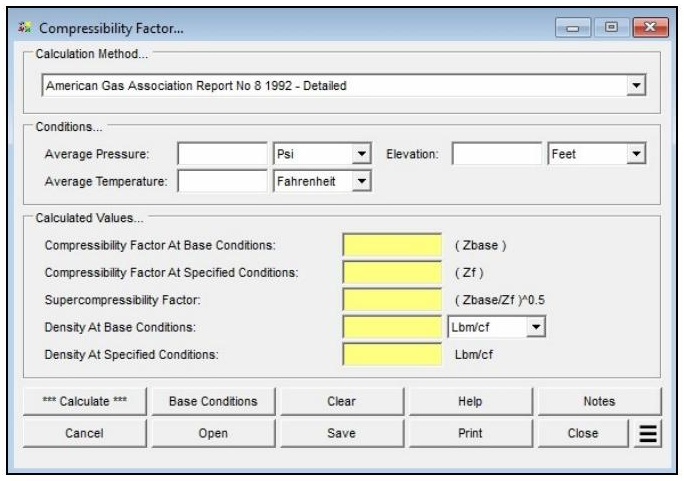
| Parameter | Description |
|---|---|
| Calculation Method | Specifies which method is used to perform the calculation. See the method summary table in the Equations section for applicable pressure ranges and required inputs. |
| Average Pressure | Specifies the average gauge pressure value at the calculation location. |
| Average Temperature | Specifies the average temperature value at the calculation location. |
| Elevation | Specifies the height above mean sea level associated with the average pressure value. Displayed when the Atmospheric Pressure Method in Base Conditions is not set to “None” or “None – Entered Value.” |
| Atm Press | Specifies the atmospheric pressure value associated with the average pressure value. Displayed only when the Atmospheric Pressure Method in Base Conditions is set to “None – Entered Value.” |
Part 2: Outputs/Reports
- If you need to modify the conditions or method, update the values and click the CALCULATE button again.
- To SAVE, click the Save command button. Provide a file name and location (.zfr file).
- To open a previously saved calculation, click the Open command button and select the .zfr file.
- To generate a REPORT, click the Print command button to access the Print Settings screen.
- To calculate Z-factor results across a range of pressures or temperatures, use Additional Actions > Calculate Table of Results.
- To compare results between two methods or conditions, use Additional Actions > Open Duplicate Calculation.
- To add a title or notes to the calculation, click the Notes command button.
Results
| Output | Description |
|---|---|
| Compressibility Factor At Base Conditions (Zbase) | The calculated compressibility factor evaluated at the specified base pressure and temperature. |
| Compressibility Factor At Specified Conditions (Zf) | The calculated compressibility factor evaluated at the specified average pressure and temperature. |
| Supercompressibility Factor (Fpv) | The calculated supercompressibility factor = (Zbase / Zf)0.5. Used in orifice and other measurement calculations. |
| Density At Base Conditions | The calculated gas density at the specified base pressure and temperature (lbm/cf or kgm/m³). |
| Density At Specified Conditions | The calculated gas density at the specified average pressure and temperature (lbm/cf or kgm/m³). |
References
- American Gas Association — Measurement, GEOP Series Book M-1, 1993.
- American Gas Association — Manual for Determination of Supercompressibility Factors for Natural Gas, Project NX-19, 1962.
- American Gas Association — AGA Report No. 8, Compressibility of Natural Gas and Other Related Hydrocarbon Gases, Second Edition, 1992 (Second Printing July 1994).
- VDI-Verlag — High Accuracy Compressibility Calculation for Natural Gases and Similar Mixtures by Use of a Truncated Virial Equation (GERG-88), 1989.
- Gas Processors Association — GPA Standard 2172-09, Calculation of Gross Heating Value, Relative Density, Compressibility, and Theoretical Hydrocarbon Liquid Content for Natural Gas Mixtures for Custody Transfer, Third Edition, 2009.
- Gas Processors Suppliers Association — Engineering Data Book, Eleventh Edition (FPS), 1998.
- American Gas Association — Report No. 8, Part 2, Thermodynamic Properties of Natural Gas and Related Gases (GERG-2008 Equation of State), First Edition, April 2017.
FAQ
-
What equations of state are available in this module?
Two equations of state are supported: AGA Report No. 8 – 2017 Detail, and AGA Report No. 8 – 2017 GERG-2008 (“Thermodynamic Properties of Natural Gas and Related Gases,” Parts 1 & 2).
The Joule-Thomson coefficient uses the method of Maric and Ivek with equation-of-state values from AGA Report No. 8, 1992.
AGA Report No. 10 – 2003 (“Speed of Sound In Natural Gas and Other Related Hydrocarbon Gases”) uses AGA 8 to calculate the speed of sound and other thermodynamic properties.
-
What information do I need before running a calculator?You need to select a calculation method, define the gas composition (either by selecting a gas properties file or by entering a mole percent for each component so the total equals 100%), and choose the property to calculate. You also set the average gas pressure and temperature, and define base conditions (base pressure, base temperature, and an atmospheric pressure method) on the Base Conditions screen.
-
How do I enter a gas composition?You can either select a prepared Gas Properties File or set the Gas Properties File to “None” and type the mole percentages directly into the Component Table. The sum of all component percentages must equal 100%. If a component is not present, leave its field empty or set it to zero. The Force Composition To Total 100% button can adjust the entered values so they sum to 100%.
-
Can I see the intermediate values behind a result?Yes. After clicking Calculate, use the See Calculation Details Additional Action to display intermediate results that can be used to verify and compare against other procedures or published examples. These include values such as Molar Density, Molecular Weight, Density at Conditions, and the Compressibility Factor.