
Introduction
The reaction force from a gas pipe blowoff includes effects from the thrust of the gas as it leaves the pipe, and stress from the static gas pressure on the outlet.
The formulas used in the calculator are taken from API RP 520, Part II:
F_{blowoff} = S_F\left(\frac{W}{366}\sqrt{\frac{kT}{(k+1)M}} + A\cdot P\right)Where:
Fblowoff is the reaction force on the blowoff valve in lbf
SF is a safety factor
W is the flow of the gas in lbm/hr.
k is the specific heat ratio (or adiabatic index) at outlet conditions.
T is the stagnation/relieving temperature at the pipe outlet in °R
M is the molecular weight of the fluid in lb/lb-mol.
A is the area of the outlet in in2
P is the static pressure within the outlet pipe (NOT the main branch) in psig.
The mass flow rate for this case is taken from the user’s estimate of the gas flow rate for the blowoff valve at outlet conditions.
W = Q\cdot \rho_{\text{gas}}= Q_\text{discharge}\cdot76.5[ \text{lbm/mcf}]\cdot G \cdot \left( \frac{P\text{[psia]}}{14.73 [\text{psia}]} \cdot \frac{518.67 [\deg R]}{T[\deg R]} \right)Where:
Qdischarge is the gas flow rate at outlet conditions in mcf.
G is the specific gravity of the ejected gas.
M = G \cdot 28.96 [\text{lb/lb-mol}]Case Guide
Part 1: Create Case
- Select the Thrust at Blow-Off application from the Design & Stress Analysis Module
- To create a new case, click the “Add Case” button
- Enter Case Name, Location, Date and any necessary notes.
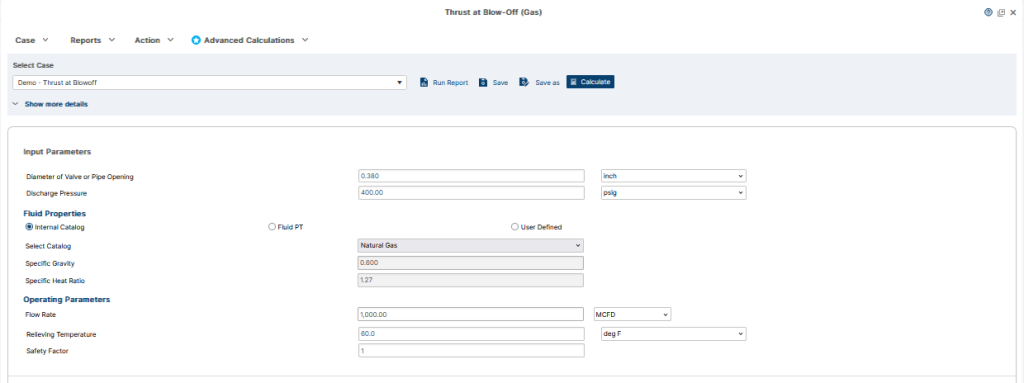
- Fill out all required Parameters.
- Make sure the values you are inputting are in the correct units.
- Click the CALCULATE button to overview results.
Input Parameters
Part 2: Outputs/Reports
- If you need to modify an input parameter, click the CALCULATE button after the change.
- To SAVE, fill out all required case details then click the SAVE button.
- To rename an existing file, click the SAVE As button. Provide all case info then click SAVE.
- To generate a REPORT, click the REPORT button.
- The user may export the Case/Report by clicking the Export to Excel icon.
- To delete a case, click the DELETE icon near the top of the widget.
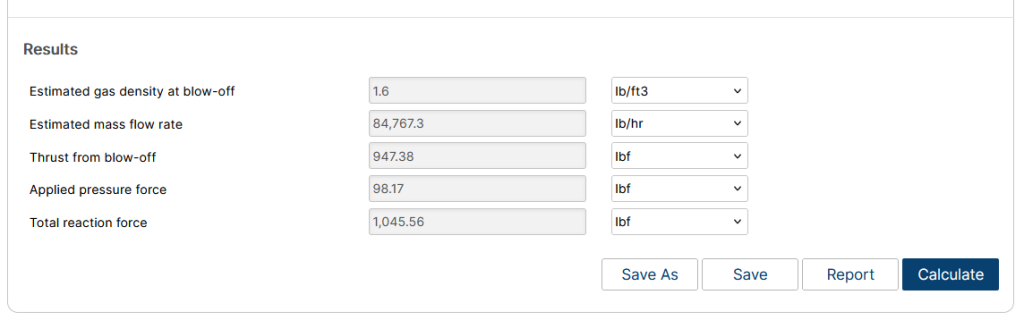
Results
- Estimated gas density at blow-off (lb/ft3)
- Estimated mass flow rate (lb/hr)
- Thrust from blow-off (lbf)
- Applied pressure force (lbf)
- Total reaction force (lbf)
References
- API RP 520: Sizing, Selection, and Installation of Pressure-relieving Devices, Part II – Installation
- ASME B31.8 – Gas Transmission and Distribution Piping Systems
- API 5L, API 5LS and API 5LX – Specification of Pipe Grade
- ASTM – Various – Weld Joint Factor
- CFR Code Part 192
- USDA-SCS Modified (Permissible Velocity of Water and Soil Erodibility)
- FHWA-HEC
- Pipeline Rules of Thumb Handbook
- Timoshenko, S – Theory of Elasticity Anchor Force
FAQ
-
Restrained versus Unrestrained Pipe (Difference in Gas vs. Liquid)?
ASME B31.4 liquid and B31.8 gas codes include calculations for the net longitudinal compressive stress that must be applied only for a restrained line that equates to a low (less than 2%) longitudinal strain. This stress status is characteristic to underground pipelines located some distance away from above ground piping facilities.
Unrestrained lines means those above ground sections of piping without axial restraint as with buried pipe with soil. In others words the soil exerts substantial axial restraint, but not fully restrained. Check Out
-
What is the Maximum Span Length of rev1?
Regarding span factors with and without water are based on bending stress and deflection. Larger diameter pipe spans require saddles for stability. Many standards that require pipes to be filled with water are based on bending and shear stresses not to exceed 1,500 psi and a deflection between supports not exceed 0.1 inches. Check Out
-
What is the model used for Thrust at Blow-Off?