
PLTB Gas & Liquid Services Cathodic Protection
Introduction
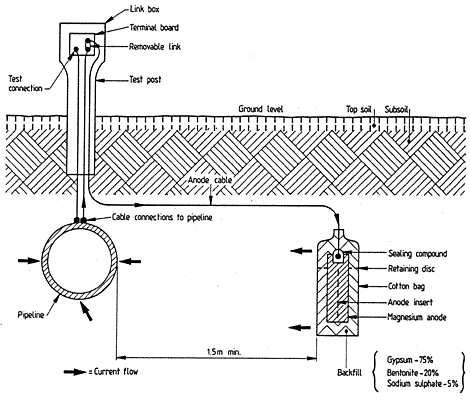
The Pipeline Toolbox is home to many tools and calculators. The PLTB User’s Guide presents information, guidelines and procedures for use during design, operations and integrity tasks for field or office applications. Pipeline cathodic protection is achieved by the supply of sufficient direct current to the external pipe surface, so that the steel-to-electrolyte potential is lowered on all the surface to values at which external corrosion is reduced to an insignificant rate. Cathodic protection is normally used in combination with a suitable protective coating system to protect the external surfaces of steel pipelines from corrosion.
Module/Application
References
- NACE Standard Practices 0169 – Latest Edition “Control of Corrosion on Underground or Submerged Metallic Piping Systems”
- Uhlig’s Corrosion Handbook (2nd Edition) Edited by: Revie, R. Winston © 2000 John Wiley & Sons
- ISO 15589-2 Petroleum and Natural gas Industries Cathodic Protection Pipeline Transportation Systems
- Pipeline Corrosion and Cathodic Protection, Third Edition, Gulf Publishing Company
Appendix of Definitions
-
Estimated Weight of a Magnesium Anode
-
Resistance to earth of an Impressed Anode Ground Bed
-
Rudenberg’s Formula for the Placement of an Anode Ground Bed
-
Resistance to Earth of a Single Vertical Anode
-
Resistance to Earth of Multiple Vertical Anode
-
Resistance to Earth of a Single Horizontal Anode
-
Resistance to Earth of a Multiple Horizontal Anode
-
Cathodic Protection Module Attenuation Calculation
-
Required Number of Anodes and Total Current Requirement
-
Power Consumption of a Cathodic Protection Rectifier
-
DCVG %IR Drop
ANODE POTENTIAL – anode-to-electrolyte potential
ANODE SLED – anodes installed on a structure and connected to the pipeline by a cable
CLOSED-CIRCUIT ANODE POTENTIAL – anode potential while electrically linked to the pipeline to be protected
COATING BREAKDOWN FACTOR – ratio of current density required to polarize a coated steel surface as compared to a bare steel surface
COLD SHUT – horizontal surface discontinuity caused by solidification of the meniscus of the partially cast anodes as a result of interrupted flow of the casting stream
DRIVING VOLTAGE – difference between the pipeline/electrolyte potential and the anode/electrolyte potential when the cathodic protection is operating
ELECTRIC FIELD GRADIENT – change in electrical potential per unit distance through a conductive medium, arising from the flow of electric current
ELECTROCHEMICAL CAPACITY – total amount of electric charge that is produced when a fixed mass (usually 1 kg) of anode material is consumed electrochemically
NOTE Electrochemical capacity is expressed in ampere hours.
FINAL CURRENT DENSITY – estimated current density at the end of the lifetime of the pipeline
NOTE Final current density is expressed in amperes per square metre.
HYDROGEN-INDUCED STRESS CRACKING – cracking due to a combination of load and hydrogen embrittlement caused by the ingress of hydrogen formed at the steel surface due to the cathodic polarization
IR DROP – voltage due to any current, measured between two points of the metal of the pipe or two points of the electrolyte, such as seawater or seabed, in accordance with Ohm’s law
NOTE IR drop and electric field gradient are related terms.
MASTER REFERENCE ELECTRODE – reference electrode, calibrated with the primary calibration reference electrode, used for verification of reference electrodes that are used for field or laboratory measurements
MEAN CURRENT DENSITY – estimated average cathodic current density for the entire lifetime of the pipeline
NOTE Mean current density is expressed in amperes per square metre.
PROTECTION POTENTIAL – structure-to-electrolyte potential for which the metal corrosion rate is considered as insignificant pitting resistance equivalent number
PRIMARY CALIBRATION REFERENCE ELECTRODE – reference electrode used for calibration of master reference electrodes
RISER – part of an offshore pipeline, including any subsea spool pieces, which extends from the seabed to the pipeline termination point on an offshore installation
UTILIZATION FACTOR – fraction of the anodic material weight of a galvanic anode that can be consumed before the anode ceases to provide the minimum required current output.
Related Links
Pipeline HUB — User ResourcesPipeline Toolbox
Table of Contents
Table of Pages
Table of Contents
- Pipeline HUB User Resources
- AC Mitigation PowerTool
- API Inspector's Toolbox
- Horizontal Directional Drilling PowerTool
- Crossings Workflow
- Hydrotest PowerTool
- Pipeline Toolbox
- Encroachment Manager
- PRCI AC Mitigation Toolbox
- PRCI RSTRENG
- RSTRENG+
- Ad-hoc Analysis
- Database Import
- Data Availability Dashboard
- ESRI Map
- Report Builder
- Crossings Workflow
- Hydrotest PowerTool
- Investigative Dig PowerTool
- Hydraulics PowerTool
- External Corrosion Direct Assessment Procedure - RSTRENG
- Canvas
- Definitions
- Pipe Schedule and Specifications Tables