
Physical Properties Calculator
The Physical Properties calculator determines key gas mixture properties — heating value, specific gravity, specific heat ratio, and viscosity — from a user-defined gas composition expressed in mole percentages. These values are required inputs for most hydraulic, compressibility, and measurement calculations in GASCalc. Note: Except for heating value and specific gravity, all computed properties are referenced to a base pressure of 14.696 psi (101.35 kPa) and a base temperature of 60°F (15.55°C); slight deviations from these base conditions generally do not require adjustment.
Background
Nearly all hydraulic calculations require knowledge of certain gas properties. These properties may include viscosity, specific gravity, and specific heat ratio. Most real-life applications involve working with a mixture of gas components, and computing the properties of a mixture requires a weighted summation of the individual component properties — the specific method depending on the property being calculated.
Viscosity
The viscosity of a gas mixture is a measure of the fluid’s resistance to flow. A higher viscosity indicates greater resistance and more difficulty in moving the fluid; a lower value means less resistance and easier flow. Although an important property, viscosity appears only as a variable in some pipe flow and hydraulic equations — equations that do not use it directly typically assume a representative value.
Heating Value
The heating value of a gas mixture is the energy contained in a specific volume of the mixture — the amount of energy that can potentially be released during combustion. The heating value is not generally used in hydraulic calculations directly, but it is used by some compressibility factor methods to convert energy-based flow units to volumetric units. The Physical Properties calculator reports the dry gross heating value for the mixture.
Specific Gravity
The specific gravity value represents the weight of the gas mixture relative to the weight of dry air. It is customarily computed on an ideal gas basis. Most hydraulic calculations use the ideal gas specific gravity. Some compressibility factor and measurement calculation methods require the “real” specific gravity, which is calculated by adjusting the ideal value using the compressibility factors of the gas mixture and the reference air mixture at the specified base conditions. The air compressibility value used in this adjustment is calculated using the AGA Report No. 8 1992 method.
Specific Heat Ratio
The specific heat ratio represents the ratio of the mixture’s constant-pressure specific heat to its constant-volume specific heat. This value is used by some valve and regulator calculation routines to calculate the speed of sound.
Equations
Heating Value — Gas Processors Suppliers Association 1998
The GPSA 1998 method calculates the gross heating value of the gas mixture using the following equation (Reference 4):
HV = \sum_{i=1}^{n} x_i \, HV_iHV = \sum_{i=1}^{n} x_i \, HV_i
Where:
HV − Gross Dry Heating Value, Btu/ft3
HVi − Heating Value for Component i, Btu/ft3
xi − Mole Fraction for Component i, decimal
The following component heating values are used as the basis for the GPSA 1998 method. All values are for a base condition of 14.696 psi (101.352 kPa) and 60°F (15.55°C).
| Component | Heating Value, Btu/ft3 | Component | Heating Value, Btu/ft3 |
|---|---|---|---|
| Methane | 1010.0 | Air | 0 |
| Ethylene | 1599.8 | Water | 50.313 |
| Ethane | 1769.6 | Argon | N/A |
| Propane | 2516.1 | Carbon Monoxide | 320.5 |
| I-Butane | 3251.9 | Carbon Dioxide | 0 |
| N-Butane | 3262.32 | Hydrogen Sulfide | 637.1 |
| I-Pentane | 4000.9 | Helium | 0 |
| N-Pentane | 4008.9 | Hydrogen | 324.2 |
| Hexane | 4755.9 | Nitrogen | 0 |
| Heptane | 5502.5 | Oxygen | 0 |
| Octane | 6249.1 | Other | 0 |
| Nonane | 6996.4 | ||
| Decane | 7743.2 |
Additional heating value calculation methods are available, each referencing a different standard: AGA Report No. 8 1992, GPA Standard 2172-86, GPA Standard 2172-09 (with optional C6+ handling via Method 1 or Method 2 of Appendix B.10). The details of these methods are too extensive to reproduce here; refer to the cited references for the complete calculation procedures.
Specific Gravity
GASCalc calculates the ideal gas basis specific gravity using the following equation, referenced to the molecular weight of dry air (Reference 6):
SG = \sum_{i=1}^{n} \frac{x_i \, MW_i}{MW_{AIR}}SG = \sum_{i=1}^{n} \frac{x_i \, MW_i}{MW_{AIR}}
The real gas basis specific gravity is calculated by adjusting the ideal value using the compressibility factors of the gas mixture and the reference air mixture at base conditions (Reference 1):
SG_R = SG \times \frac{Z_{AIR}}{Z}SG_R = SG \times \frac{Z_{AIR}}{Z}
Where:
SG − Specific Gravity (Ideal Gas Basis), dimensionless
SGR − Specific Gravity (Real Gas Basis), dimensionless
MWi − Molecular Weight of Component i, g/mol
MWAIR − Molecular Weight of Dry Air, g/mol (28.9625)
xi − Mole Fraction for Component i, decimal
Z − Compressibility Factor for the Gas Mixture at Base Conditions, dimensionless
ZAIR − Compressibility Factor for the Reference Air Mixture at Base Conditions, dimensionless
| Component | Molecular Weight | Component | Molecular Weight |
|---|---|---|---|
| Methane | 16.043 | Air (dry) | 28.9625 |
| Ethylene | 28.054 | Water | 18.0153 |
| Ethane | 30.07 | Argon | 39.948 |
| Propane | 44.097 | Carbon Monoxide | 28.01 |
| I-Butane | 58.123 | Carbon Dioxide | 44.01 |
| N-Butane | 58.123 | Hydrogen Sulfide | 34.082 |
| I-Pentane | 72.15 | Helium | 4.0026 |
| N-Pentane | 72.15 | Hydrogen | 2.0159 |
| Hexane | 86.177 | Nitrogen | 28.0134 |
| Heptane | 100.204 | Oxygen | 31.9988 |
| Octane | 114.231 | Other | 0 |
| Nonane | 128.258 | ||
| Decane | 142.285 |
Specific Heat Ratio
GASCalc calculates the specific heat ratio of the gas composition using the following equations (Reference 5):
k = \frac{C_P}{C_V} \qquad C_P = \sum_{i=1}^{n} x_i C_{P_i} \qquad C_V = \sum_{i=1}^{n} x_i C_{V_i}k = \frac{C_P}{C_V} \qquad C_P = \sum_{i=1}^{n} x_i C_{P_i} \qquad C_V = \sum_{i=1}^{n} x_i C_{V_i}
Where:
k − Specific Heat Ratio, dimensionless
CP − Specific Heat at Constant Pressure, Btu/lbm·°F
CV − Specific Heat at Constant Volume, Btu/lbm·°F
CPi − Constant Pressure Specific Heat of Component i, Btu/lbm·°F
CVi − Constant Volume Specific Heat of Component i, Btu/lbm·°F
xi − Mole Fraction for Component i, decimal
| Component | CP, Btu/lbm·°F | CV, Btu/lbm·°F |
|---|---|---|
| Methane | 0.5266 | 0.400 |
| Ethylene | 0.3573 | 0.296 |
| Ethane | 0.4079 | 0.347 |
| Propane | 0.3873 | 0.343 |
| I-Butane | 0.3866 | 0.348 |
| N-Butane | 0.3949 | 0.361 |
| I-Pentane | 0.3828 | 0.3605 |
| N-Pentane | 0.3979 | 0.3699 |
| Hexane | 0.3857 | 0.3753 |
| Heptane | 0.3841 | 0.3794 |
| Octane | 0.3829 | 0.3824 |
| Nonane | 0.3820 | N/A |
| Decane | 0.3813 | N/A |
| Air | 0.2399 | 0.1711 |
| Water Vapor | 0.44478 | 0.334 |
| Argon | 0.1233 | 0.0739 |
| Carbon Monoxide | 0.2484 | 0.1779 |
| Carbon Dioxide | 0.1992 | 0.1535 |
| Hydrogen Sulfide | 0.2383 | 0.345 |
| Helium | 1.2404 | 0.752 |
| Hydrogen | 3.446 | 2.443 |
| Nitrogen | 0.2483 | 0.1772 |
| Oxygen | 0.2189 | 0.1565 |
| Other | N/A | N/A |
Viscosity
GASCalc calculates the absolute (dynamic) viscosity of the gas composition using the following equation. The individual molecular weight values are the same as those listed for the Specific Gravity equation above (Reference 8):
\mu = \frac{\displaystyle\sum_{i=1}^{n} x_i \, \mu_i \, \sqrt{MW_i}}{\displaystyle\sum_{i=1}^{n} x_i \, \sqrt{MW_i}}\mu = \frac{\displaystyle\sum_{i=1}^{n} x_i \, \mu_i \, \sqrt{MW_i}}{\displaystyle\sum_{i=1}^{n} x_i \, \sqrt{MW_i}}
Where:
μ − Dynamic or Absolute Viscosity of the mixture, lbm/ft·sec
μi − Viscosity of Component i, lbm/ft·sec
MWi − Molecular Weight of Component i, g/mol
xi − Mole Fraction for Component i, decimal
| Component | Viscosity, Micropoise | Component | Viscosity, Micropoise |
|---|---|---|---|
| Methane | 107 | Air (dry) | 179 |
| Ethylene | 101 | Water | 95 |
| Ethane | 89 | Argon | 224.1 |
| Propane | 75 | Carbon Monoxide | 184 |
| I-Butane | 71 | Carbon Dioxide | 147 |
| N-Butane | 73 | Hydrogen Sulfide | 130 |
| I-Pentane | 66 | Helium | 193 |
| N-Pentane | 66 | Hydrogen | 87 |
| Hexane | 63 | Nitrogen | 173 |
| Heptane | 59 | Oxygen | 195.7 |
| Octane | N/A | Other | 0 |
| Nonane | N/A | ||
| Decane | N/A |
Case Guide
Part 1: Create Case
- Select the Physical Properties application from the Gas Properties Module.
- Click the Clear command button to set all values to an empty (null) value.
- Click the Base Conditions command button, enter an appropriate base pressure and temperature, then click Apply.
- Select the desired dimensional units for all data items.
- Enter mole percentage values for each gas component present in the Gas Composition section. The sum of all values must equal 100%. Leave unused components empty or set to zero. Use the Force Composition To Total 100% button if needed to normalize the values.
- In the Calculated Property Values section, select a Heating Value Calculation Method from the dropdown list.
- If desired, check the Override checkbox for any calculated property to enter a value manually instead of having it computed.
- For Specific Gravity, check the Real checkbox to compute the real gas basis value instead of the ideal gas basis value.
- Click the Calculate command button to compute all property values.
Input Parameters
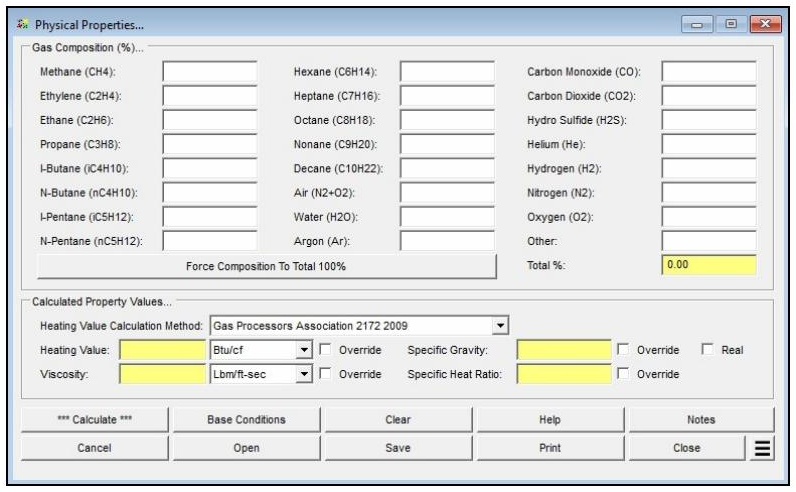
| Parameter | Description |
|---|---|
| Gas Composition | Specifies the composition values of the gas, expressed as mole percentages. The sum of all percentages must equal 100%. If a component does not exist in the gas, leave its field empty or set its value to zero. Components include: Methane, Ethylene, Ethane, Propane, I-Butane, N-Butane, I-Pentane, N-Pentane, Hexane, Heptane, Octane, Nonane, Decane, Air, Water, Argon, Carbon Monoxide, Carbon Dioxide, Hydrogen Sulfide, Helium, Hydrogen, Nitrogen, Oxygen, and Other. The Other component balances the composition to 100% but does not contribute to computed property values. |
| Heating Value Calculation Method | Specifies the method used to calculate the heating value. Available options include AGA Report No. 8 1992, GPA Standard 2172-86, GPA Standard 2172-09, GPA Standard 2172-09 C6+ Method-1, GPA Standard 2172-09 C6+ Method-2, and GPSA 1998. |
| Override | When selected, allows the associated calculated property value (Heating Value, Viscosity, Specific Gravity, or Specific Heat Ratio) to be manually entered rather than computed. |
| Real (Specific Gravity) | When selected, the Specific Gravity value is computed on a real gas basis by adjusting the ideal gas value using the compressibility factors of the gas mixture and the reference air mixture at the specified base conditions. |
| Heating Value units | Selects the unit system for the displayed Heating Value result (e.g., Btu/ft3 or MJoules/m3). |
| Viscosity units | Selects the unit system for the displayed Viscosity result (e.g., Lbm/ft-sec or Centipoise). |
| Base Conditions | Sets the base pressure and temperature used for the calculation. Affects the Heating Value and Specific Gravity results directly. |
Part 2: Outputs/Reports
- Review the calculated property values displayed in the Calculated Property Values section. The Total % field shows the running sum of entered composition values and must equal 100 before results are valid.
- To save the calculation, click the Save command button. Calculation files use the .prp extension.
- To save the entered or calculated property values to a gas properties file for use in other GASCalc calculations, use the Save function. Once saved, the properties file can be assigned to other calculation routines via their Base Conditions screen.
- To print the data values and results, click the Print command button and configure the Print Settings screen.
- To compare results by changing a value without re-entering all data, use the Open Duplicate Calculation Additional Action.
Results
| Output | Description |
|---|---|
| Total % | Displays a running total of the summation of the entered component mole percentage values. Must equal 100% for the calculation to be valid. |
| Heating Value | Displays the calculated dry gross heating value for the gas mixture in the selected units (Btu/ft3 or MJoules/m3). Computed using the selected Heating Value Calculation Method. |
| Specific Gravity | Displays the calculated specific gravity for the composition — a dimensionless ratio of the gas mixture weight to dry air weight. Reported on an ideal gas basis by default; select the Real option to compute the real gas basis value. |
| Specific Heat Ratio | Displays the calculated ratio of constant-pressure specific heat to constant-volume specific heat for the mixture. A dimensionless value used by valve and regulator routines to calculate the speed of sound. |
| Viscosity | Displays the calculated absolute (dynamic) viscosity for the gas mixture in the selected units (Lbm/ft-sec or Centipoise). |
Note: Except for heating value and specific gravity, all computed properties are referenced to a base pressure of 14.696 psi (101.35 kPa) and a base temperature of 60°F (15.55°C). If a gas component is missing from the available list, combine its value with a similar component or enter it in the Other field. If the missing component is a significant part of the composition, manually computing properties using the equations in the Equations section above is recommended. The number of decimal places displayed for any calculated item can be set under File > Preferences > Decimals.
References
- American Gas Association, AGA Report No. 8, Compressibility of Natural Gas and Other Related Hydrocarbon Gases, 1992, 1994 Printing.
- Gas Processors Association Standard 2172-86, “Calculation of Gross Heating Value, Relative Density, and Compressibility Factor for Natural Gas Mixtures from Compositional Analysis,” 1986.
- Gas Processors Association, GPA Standard 2172-09, Calculation of Gross Heating Value Relative, Density Compressibility, and Theoretical Hydrocarbon Liquid Content for Natural Gas Mixtures for Custody Transfer, Third Edition, 2009.
- Gas Processors Suppliers Association, Engineering Data Book, Eleventh Edition – FPS, 1998.
- Gas Processors Association, GPA Standard 2145-09, Table of Physical Properties for Hydrocarbons and Other Compounds of Interest to the Natural Gas Industry, 2009.
- Industrial Press, Gas Engineers Handbook, 1965.
- Wiley, Handbook of Engineering Fundamentals – Eshbach, Third Edition, 1975.
- American Gas Association, Gas Engineering and Operating Practices – System Design, GEOP Series Book D-1, 1990.
- Institute Of Gas Technology, Research Bulletin 23, Viscosities of Natural Gas Components, 1953.
FAQ
-
What equations of state are available in this module?
Two equations of state are supported: AGA Report No. 8 – 2017 Detail, and AGA Report No. 8 – 2017 GERG-2008 (“Thermodynamic Properties of Natural Gas and Related Gases,” Parts 1 & 2).
The Joule-Thomson coefficient uses the method of Maric and Ivek with equation-of-state values from AGA Report No. 8, 1992.
AGA Report No. 10 – 2003 (“Speed of Sound In Natural Gas and Other Related Hydrocarbon Gases”) uses AGA 8 to calculate the speed of sound and other thermodynamic properties.
-
What information do I need before running a calculator?You need to select a calculation method, define the gas composition (either by selecting a gas properties file or by entering a mole percent for each component so the total equals 100%), and choose the property to calculate. You also set the average gas pressure and temperature, and define base conditions (base pressure, base temperature, and an atmospheric pressure method) on the Base Conditions screen.
-
How do I enter a gas composition?You can either select a prepared Gas Properties File or set the Gas Properties File to “None” and type the mole percentages directly into the Component Table. The sum of all component percentages must equal 100%. If a component is not present, leave its field empty or set it to zero. The Force Composition To Total 100% button can adjust the entered values so they sum to 100%.
-
Can I see the intermediate values behind a result?Yes. After clicking Calculate, use the See Calculation Details Additional Action to display intermediate results that can be used to verify and compare against other procedures or published examples. These include values such as Molar Density, Molecular Weight, Density at Conditions, and the Compressibility Factor.