
Introduction
No pump is perfect with 100% efficiency. Energy lost in friction and hydraulic losses transforms to heat – heating up the fluid transported through the pump and the piping. PLTB calculates this temperature rise.
Throttling the discharge valve will result in a temperature increase. Reduced efficiency of pumps results in temperature increases. : t_y = \frac{H \left( \frac{1}{n} – 1 \right)}{780 c_p} [\text{\textdegree}F]
t_y = \frac{H \left( \frac{1}{n} - 1 \right)}{780 c_p} [\text{\textdegree}F]
Where:
𝑡𝑦 − Temperature Rise due to Pumping (℉)
𝐻 − Total Head (ft)
𝑛 − Pump Efficiency
𝑐𝑝 − Specific Heat (Btulb⁄℉)
Case Guide
Part 1: Create Case
- Select the Temperature Rise Due to Pumping application from the Pump Module
- To create a new case, click the “Add Case” button
- Enter Case Name, Location, Date and any necessary notes.
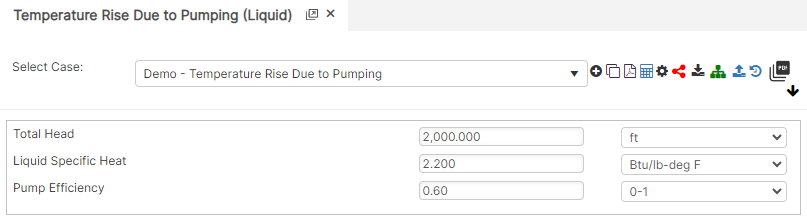
- Fill out all required Parameters.
- Make sure the values you are inputting are in the correct units.
- Click the CALCULATE button to overview results.
Input Parameters
- Total Head (ft)
- Liquid Specific Heat (Btu/lb ˚F)
- Pump Efficiency (0-1)
Part 2: Outputs/Reports
- If you need to modify an input parameter, click the CALCULATE button after the change.
- To SAVE, fill out all required case details then click the SAVE button.
- To rename an existing file, click the SAVE As button. Provide all case info then click SAVE.
- To generate a REPORT, click the REPORT button.
- The user may export the Case/Report by clicking the Export to Excel icon.
- To delete a case, click the DELETE icon near the top of the widget.
Results
- Temperature Rise (˚F)


References
- ASME B31.4 – 1998 Edition “Pipeline Transportation Systems for Liquid Hydrocarbons and other Liquids”, Art. 404.1
- API 1117 – Movement of In-Service Pipelines
- API 5L, API 5LS and API 5LX – Specification of Pipe Grade
- ASTM – Various – Weld Joint Factor
- CFR Code Part 192
- MMS Regulations
- USDA-SCS Modified (Permissible Velocity of Water and Soil Erodibility)
- Pipeline Rules of Thumb Handbook